When I started college in 1973, it was a time of great political and social ferment in the US, and in a lot of other places too. I barely had time for the whole new academic life that I was starting, because I was steeped in all kinds of activism. On Saturday mornings our regular routine, almost like a social event, was to picket the local Safeway. A large and powerful supermarket chain that persisted in selling non-union Iceberg lettuce, and Thompson seedless grapes. California, which is one of this country’s rich and abundant agricultural centers, is the destination for a large and necessary pool of laborers to harvest and pick our wealth of food crops. Farm work is back-breaking work, long hours exposed to inclement weather of all kinds. The kind of work that no one wants to do that largely falls to immigrants. The majority of our farm workers came from Mexico, and although the wages and conditions of farm work in this country are shamefully low, it was more than they could earn back home. Whole families of Mexican migrants worked the fields and lived in deplorable, slave-like conditions, migrating from region to region, following the crops.
I once had a client who came from Holland, way back in the early days of my study of neglect. He grew up on a tulip farm. The scene sounded so picturesque, except that by the age of five, he was working in the field for three hours before going off to school in the mornings, and three hours more in the afternoons when he got home. Somehow children have readily been included in this labor. And from him, I learned still more about the never-ending requirements of farming and harvesting.
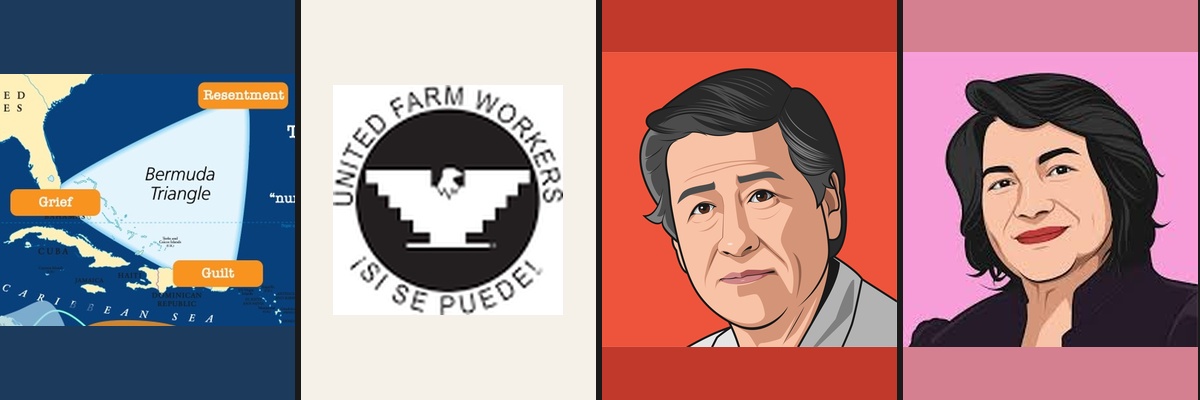
In 1962, two Mexican Americans, Cesar Chavez and Dolores Huerta, had the courage and the audacity to begin to organize the farm workers, and try to win collective bargaining power to gain fairer pay and humane living conditions. Chavez was born on March 31, which happens to be the day I am writing this, in 1927. His parents owned a small farm when he was small, but they lost everything in the great Depression of the 1930’s. Left first without their source of income and then without their home, Cesar, his parents and five siblings joined the ranks of migrant workers, trudging like vagabonds from one harvest to the next. Of course, education was hard to work into the laboring life of children. By the time Cesar dropped out of school, demoralized, after eighth grade, he had attended 35 different schools and was often bullied for his poor English as his family largely spoke in their native tongue. Poverty, racism, inaccessibility of education and a long life or hard labor were the defining qualities of his growing up. Organizing the United Farm Workers, which became national in 1966 was a monumental and heroic accomplishment.
Chavez was a hero, as was his collaborator, Dolores Huerta, and we admired and idealized them both. They were perhaps the first iconic Hispanic big names and iconic faces, until Carlos Santana came on the scene in 1969. Chavez’s picture and name have become part of our progressive and left-wing culture, ever since…well until now.
Sexual abuse
It was with shock and profound dismay, that I heard the news this week, that survivors had come forward and reported being sexually abused as children by Cesar Chavez. Even Huerta herself reported having been raped by him. She never spoke of it until now, for fear of damaging the union. I was heartbroken. Being a long-time champion of survivors of childhood sexual abuse, I could not bear the thought that this seeming symbol of goodness, was a perpetrator. I simply had a hard time reconciling, holding those pieces, those parts together. How could this be? I remember being distressed in a similar way when I learned that Mahatma Gandhi, always a hero of my mother’s, was harsh and controlling of his wife. Not sexually abusive or overtly violent as far as I could tell, but extreme, controlling and harsh. Again, I found it unbearable, this gentle soul who taught the world about non-violence resistance and civil disobedience, could be so extreme and demanding of obedience, at home. How can it be that someone who seems so “good” can also be so “bad?
The recent story of Gisele Pelicot captured the news not long ago. The brave woman whose husband regularly drugged her and made her available to be raped by several hundred men while unconscious. It was shocking and painful news. In reading her memoir, A Hymn to Life: Shame Has to Change Sides (Penguin, 2026) Pelicot describes learning about what had happened to her, from a detective. In effect, she was informed that her 50-year marriage to the man she thought she knew, the father of her children, was completely other than what she knew. She describes the idyllic first years and decades of their life together. The shock was overwhelming, the shame, incredulity, confusion and immense loss. She describes her powerful journey of reconciling the incompatible pieces.
Many of us, and our survivor clients, to a greater or lesser extent wrangle with similar questions about our/their own parents and perpetrators? There may be great love, respect, admiration, and gratitude alongside pain and rage about trauma and neglect. Which is it? How do we hold it all?
I have come to call this fierce confluence of feelings, the Bermuda Triangle, named for a mysterious mythical spot in the Atlantic Ocean, where, as the stories go, ships and planes were mysteriously and dramatically crashed and wrecked, then vanishing without a trace. The violent feelings that collide irreconcilably, often about perpetrators and loved ones, is a similar, and similarly unhomogenized clash of rage, grief and guilt, that cannot seem to find a homeostatic balance. They roil around inside, refusing to harmonize for a long time. Ultimately through long and diligent trauma work, we make our peace with all being real and having their place. Not a smooth voyage by any means.
Reconciliation
This day, Cesar Chavez’ birthday has been a holiday here in San Francisco. Its name was changed to United Farm Workers’ Day. But there are streets named after him, murals bearing his image, large and small monuments to his achievement and contribution to the plight of immigrant and migrant agricultural workers, a plight which is once again commanding our concern and attention. There is debate in town about how we handle this. Does the reality of his heinous abuse of children and women eclipse his good works? Does it erase them? I find I am painfully conflicted about this. Holding positive and negative in the same frame? Some of us have found a way to do this, or to co-exist with the contradictions in our own lives and families. Others continue to suffer the loss, or the battle simply refuses to be quieted.
For many with neglect trauma, comparing becomes an insidious habit. Never quite knowing where I stood, I was always scanning for who got what, and how much I got by comparison. Invisible, I tried to assess what the other had that I didn’t have that compelled attention when I couldn’t. Who has the “worst worst?” Even, “who is the thinnest in the room?” Comparing invariably makes us feel worse, more deficient, more less than. We always come up even shorter. I try to work with myself and others not to do it. So how do we work out this question? How do we measure or assess the valence? Or is there an answer? I guess I don’t know.
What do you think?