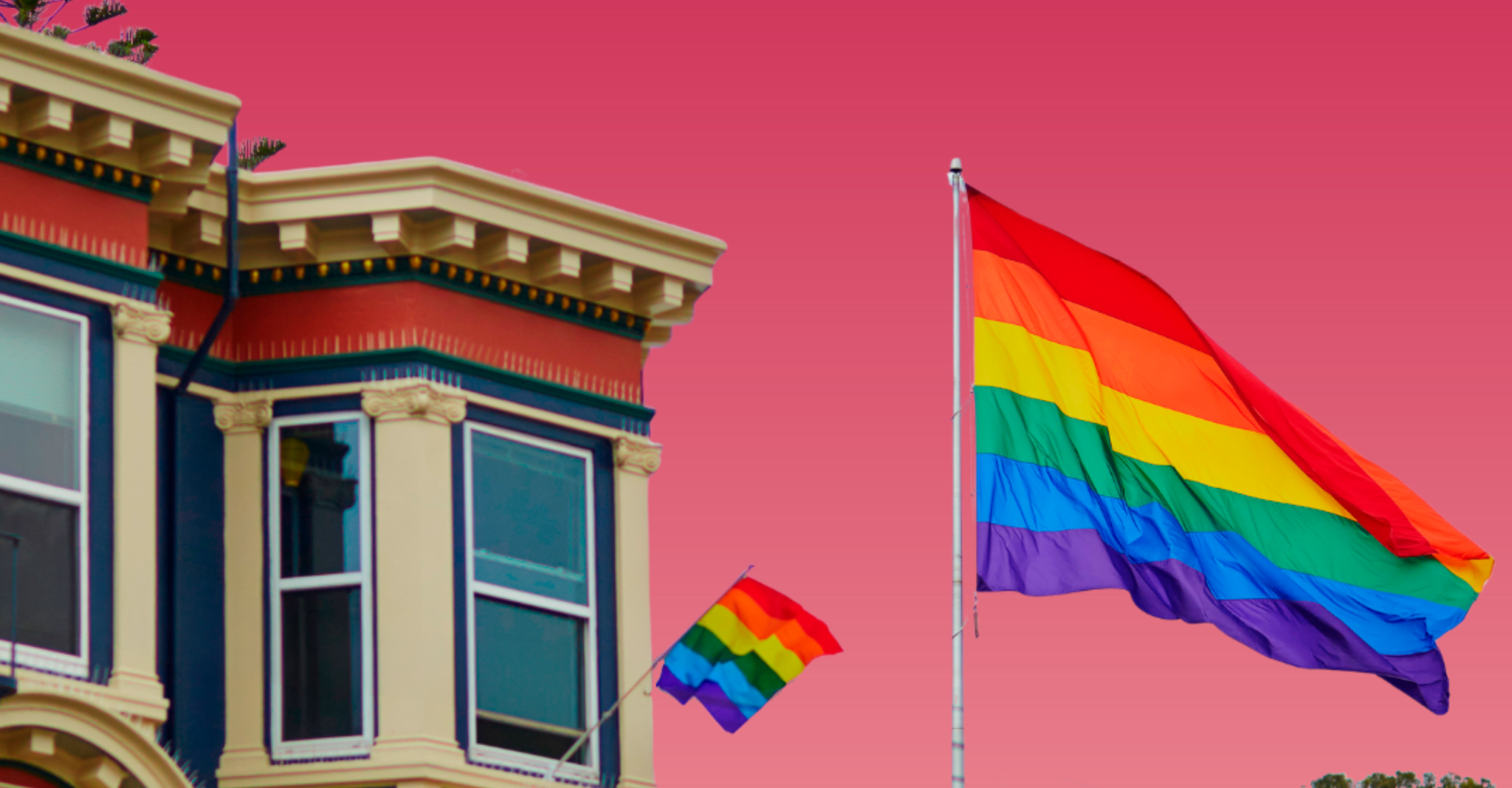
Last week we went to see the museum exhibit of Monet in Venice. It was beautiful, all the soft muted colors of water lilies and more. I do love the gentle pastel colors, and I do love my pink. But admittedly, I will take Diego Rivera any day. I prefer the hard lines of realism and the brilliant primary colors. I think of color as one of the great pleasures of life, and even with food, I am often partial to the colors over the combination of ingredients. In June in San Francisco, USA, where I live, the streets are alive with bright waving rainbow flags to celebrate Pride. They show up vividly against the perennially grey foggy summer skies. We even have a rainbow search light beaming off the Civic Center building, fog permitting. Although I am an old straight married lady, I am proud that our city is relatively sex positive and LGBTQI friendly. I was proud when our straight white mayor led the charge for same sex marriage both locally and beyond. It is so important to me that everyone be able to freely love who they want without shame or sanction.
I remember when same sex marriage was first legalized here in 2004. As it happened, we were at a Melissa Etheridge concert at the historic Fillmore Auditorium that night. Melissa was one of the first openly lesbian rock stars, at least as far as I knew. The atmosphere at that show was wildly euphoric, and for a while, there were long lines of couples outside the Civic Center, the very same building that projects the beautiful lights. Finally, they could get that legal validation that their union existed and was accepted, to some extent, in the eyes of the world.
I know many think of the institution of marriage as being just one more trapping of capitalism that they don’t particularly endorse. I for one, have always loved it, once I got over the hump of feeling at least nominally safe enough to go through with it. I remember after being married, the first time I went to the bank and deposited my money. I had the perhaps astonishing thought, “this is for us!” What was astonishing to me, was to actually have an “us.” It was perhaps the first time ever, I felt a sense of affiliation, of belonging, of being part of something. A missing experience for the child of neglect, who feels rather lost in space without a tether. Some feel yoked by it. I feel connected.
We are certainly not out of the woods with sexual justice by any means, here or anywhere as far as I know. Same sex marriage went through some zigs and zags before it stayed solidly on the books here. And it is indeed a question whether anything is solid these days, especially where equality and justice are concerned. Trans people are perhaps some of the most victimized of minority groups in most of the world, and there continues to be great ignorance and prejudice, even among more the more “enlightened” among us. I continue to learn more and more all the time, and I am humbled by some of the mistakes or questions I still stumble with. The same is true for other non “cis” relationship configurations. But nonetheless we have made some progress in the US. It was not that long ago that same sex activity was punishable by prison or worse, (and in some countries it still is.) And homosexuality was listed as a diagnosable mental disorder. We do have something to be proud of, and despite the commotion in the local Major League Baseball world, where some team members rebelled against the team issued rainbow adorned pride baseball caps, I am mostly proud of the local community. We live near the acclaimed SF Castro District, always lively and alive with color!
Shame
For many of us, the opposite of pride is shame, a feeling all too familiar to the child of neglect. Being by nature self-referential, a child readily concludes, if I am ignored, overlooked, unseen, unknown, essentially invisible, it is because I don’t matter. I am unimportant, inherently worthless and therefore “less-than.” Everything is my “fault,” as there is no other, and the impulse is to hide and withdraw. Recently I have been making a study studying about violence, inspired or compelled by the state of the world, and certainly my long personal journey of political outrage and activism.
One of my most trusted experts on the subject of violence, has been New York University psychiatrist James Gilligan, whom I first encountered at a conference shortly after the publication of his groundbreaking book Violence (1997, Knopf.) That book has become a staple reference and cornerstone of my exploration. Gilligan identifies shame as being one of the key precipitants of violence. The experience of being treated as, or feeling less than or inferior, of inhabiting less power, agency and dignity, of not mattering fuels the rage that impels violent action. The glaring disparity between “haves” and “have nots” and the injustice of that, drives it, resulting in perpetration and the victimization of others. Turning against others who may be still “weaker” than oneself or striking out against those who have or appear to have more. “It’s not fair!” is a child’s refrain, which is of course true, excepting for the fact that life rarely is.
Gilligan worked with and studied the most violent of convicted prisoners, inside maximum-security US prisons, and psychiatric hospitals for the “criminally insane” for over three decades. In the prisons. What he encountered was that certainly inside that system, the worst insult to dignity, or the greatest point of shame, was to be weak, or not a “man,” to have one’s manhood diminished or denied. The prison system, which for the most part deprives inmates of their natural and customary sexual life, whatever that may be, in his view is categorically emasculating, and creates a culture inside not only of sexual hunger and “horniness,” but increased shame.
Gilligan, married 64 years to feminist philosopher, Carol Gilligan, is no stranger to questions of where the non-male fits into the picture. Violence was written decades before awareness of non-binary or “other” genders, and he would probably update his views to account for this. Perhaps he already has, and I simply have not found the updated work yet. In the binary cultural gender construct, non-males (in his model, women,) cannot begin to compete, are by nature even more “less than.” In the history and literature of at least Western cultures, a woman can only challenge or dishonor a man’s superiority or “manhood,” through sex. Either overwhelming his desire with the strength of her erotic attraction or betraying him sexually with another partner. Either defies his manhood and casts shame upon him.
Gilligan describes in painfully graphic detail, the exaggeration and resultant violence of all this inside prison walls. Sexual violence is vicious and rampant, prison staff ignores or even condones, sexual violence and the ostracizing of the “weak,” and there is no help or protection for the victimized and exploited. They are thus further “dishonored” and “weakened,” not to mention traumatized and often even injured. Gilligan calls it institutional homophobia, in addition to the notorious racism inside these walls.
What am I getting at here? Shame begets violence. Our system of punishment institutionalizes and perpetuates shame which then produces more violence, and of course trauma. Those who do manage to exit the prison system – in effect, get out alive – are anything but less inclined toward violence as a result. And again, shame is a profound and ubiquitous result of early neglect. Oy vey. I call it a “gordian knot.”
Respair
This is supposed to be a weekend and an article about pride! Yes, there have been incidents of violence at some of the weekend’s pride events, but for the most part it has been joyous, at least here. Gilligan speaks of pride as a powerful impetus for creativity and purposeful, meaning-making work. Feeling good about oneself inspires agency and action. I matter and I have value. What I do has value. A default and an echoing refrain among neglect survivors, is the shame ridden belief, “I don’t matter.’ It is a ready and sorry explanation for the experience of being invisible, unseen, ignored, forgotten or abandoned. Another powerful reminder of how we must make it stop: stop the feedback loop trauma and neglect-shame-violence-more trauma, neglect… We must make it stop. And today I heard a program that put another, new spin on the cycle. It described the now apparently frequent experience of artificial intelligence, AI, evoking a feeling of “I don’t matter…” by replacing human jobs and even creative endeavors, and seemingly in no time. Oh no…
Recently I learned a new word. Although a 50-year proponent of body-oriented practice, admittedly I do love words! This one, when I encountered it, at first, I thought it was a typo, but a large and prominent typo in the NY Times seemed unlikely, so I looked it up: respair. At first, I thought it was supposed to be repair or despair. I looked in my trusted American Heritage Dictionary, always by my side when reading. Not there, so I looked in Google which located it in the Oxford English dictionary, archaic English defined as “the return of hope after a period of despair.” As a verb, respair means “to have hope again.” Time to resuscitate that word, and the feeling it describes. Last night the fog cleared, and the rainbow search lights off City Hall were brilliant and visible well into the night. Only today, I was reminded that the anniversary of same sex marriage in SF was 25 June, just a couple of days ago, and long lines of couples again lined the courthouse steps to tie the knot on that historic day. Happy Pride everyone, and let’s all observe and generate respair!